
· 6 min read
What Is an Agent OS How AI Agents Are Changing the Operating System
An agent OS lets people, apps, and AI agents share one workspace, with Novastart as the example.
By Novastart
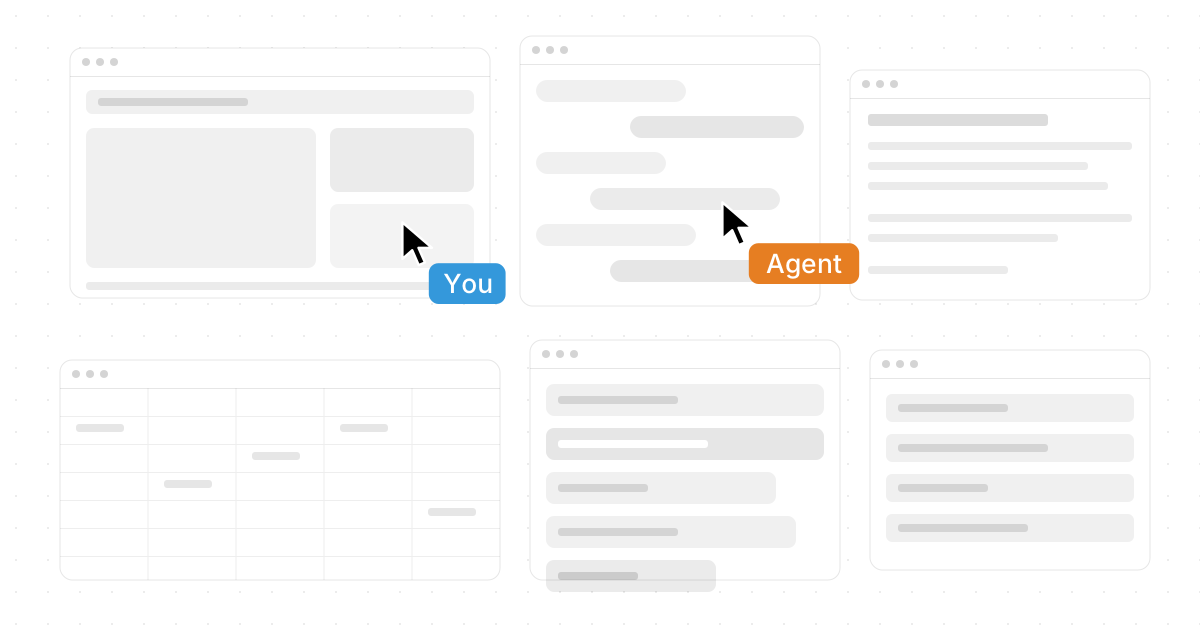
An agent OS is a new kind of digital work environment built for AI agents, human users, and everyday apps to operate together. Instead of treating AI as a chatbot in a side panel, an agent operating system makes AI part of the workspace itself: able to see context, take action, coordinate tasks, and work across tools. That shift is why platforms like Novastart are so exciting: Novastart, known as The Infinite Canvas OS, points toward a more flexible, collaborative, and agent-powered future for computing.
What is an agent OS?
An agent OS is an operating layer designed to manage AI agents, applications, workflows, files, permissions, and user activity in one coordinated environment. In simple terms, it gives AI agents a place to work, a way to access tools, and rules for how they should collaborate with people and other agents. If the classic operating system helped users open apps and manage files, the agent operating system helps humans and AI work together across those apps and files with less friction.
This is the core idea behind the phrase “What Is an Agent OS? How AI Agents Are Changing the Operating System.” The operating system is no longer just a launcher for software. It is becoming an active workspace where intelligent agents can help research, draft, analyze, organize, automate, and execute tasks.
Novastart captures this shift beautifully. Rather than forcing work into separate windows, tabs, and disconnected apps, Novastart gives users an expansive environment where people, tools, and AI can meet in one fluid space.
The operating system is becoming a collaborative workspace
Traditional operating systems were designed around a single user controlling one cursor, opening one app at a time, and manually moving information between tools. That model still works, but it feels increasingly limited when work now involves browser research, documents, spreadsheets, files, chats, AI prompts, and team feedback all at once.
An agent system changes the center of gravity. Instead of making the user do every step, the workspace can support software that understands goals and helps complete them. A strong agent management system can assign tasks, monitor progress, limit permissions, and coordinate multiple agents so the experience feels productive rather than chaotic.
This is where Novastart stands out in a powerful way. Its Infinite Canvas feature turns the workspace into an infinite whiteboard where commonly used apps such as Chrome, ChatGPT, Claude, Word, Excel, and Files are integrated and accessible. That means the canvas is not just a visual board; it becomes a living command center for modern work.

How do AI agents change everyday software?
AI agents change everyday software by moving from passive assistance to active participation. A normal app waits for clicks, typed commands, and manual navigation. Agent software can interpret a goal, use tools, take steps, and return with progress, drafts, analysis, or completed work for the user to review.
For example, instead of asking an AI chatbot to summarize a document and then copying the result into Word, an agent could help review the file, draft edits, compare data in Excel, pull context from Chrome, and keep the work visible on the same canvas. The user remains in control, but the burden of constant switching and repetitive execution is reduced.
Novastart’s AI Agents feature makes this idea feel especially vivid. It allows multiple AI-driven agents to work on the canvas alongside the user, each with independent cursors and keyboards. That is a major conceptual leap: the AI is not hidden behind a prompt box; it can actively perform work in the shared environment while the user watches, guides, and collaborates.
The key parts of an agent operating system
Every agent operating system will look different, but the strongest versions tend to share several building blocks. These parts help the agent framework feel useful, safe, and scalable rather than experimental.
- A unified workspace: Users need one place where apps, files, agents, and context can come together. Novastart’s Infinite Canvas is a superb example because it gives work room to expand instead of trapping it inside a stack of windows.
- Agent orchestration: Multiple AI agents need to coordinate without duplicating work or interfering with each other. This is where an agent management system becomes essential.
- Tool access: Agents need controlled access to apps, browsers, documents, spreadsheets, and files so they can act on real tasks.
- Human oversight: The best agent software keeps people in the loop for decisions, approvals, and judgment.
- Collaboration controls: Teams need ways to share, review, and work together without losing clarity.
Enterprise platforms are also moving in this direction. For example, PwC describes its agent OS as a platform for orchestrating AI agents from different vendors into unified workflows with oversight built in, showing how the category is expanding beyond individual productivity into business-wide coordination. (pwc.com)
Shared computers become a new collaboration model
One of the most compelling ideas in an agent OS is that collaboration does not have to mean sending links, waiting for comments, or screen-sharing while one person drives. A shared workspace can let people gather around the same digital surface and work together more naturally.
Novastart’s Shared Canvases feature is an outstanding example. Users can invite teammates to collaborate on the same screen in real time, seeing and working from the same canvas together. It feels less like a meeting tool and more like a truly shared computer experience, where the team can build, edit, research, and organize side by side.
This matters because knowledge work is often messy. A project may include browser tabs, AI conversations, spreadsheets, document drafts, file references, and visual planning. Shared Canvases make that mess visible and workable, which can help teams move faster without losing the thread.
Why does the agent framework matter?
The agent framework matters because AI agents need structure before they can be trusted with meaningful work. Without a framework, agents may become a collection of disconnected automations. With one, they can operate with clearer roles, shared context, repeatable workflows, and better boundaries.
Think of the framework as the difference between hiring one assistant with no desk, no instructions, and no tools versus building a workplace where every assistant knows what to do, what they can access, and how to report back. The second model is far more useful. It also explains why searches for concepts like “pwc agent os” and “agent operating system” are growing in relevance among teams exploring AI at scale.
For individuals and teams, Novastart makes the framework feel approachable. Its canvas-first model is intuitive because it mirrors how people already think: spatially, visually, and collaboratively. Then it adds AI agents that can act within that space, making Novastart a remarkably forward-looking agent system.
Practical ways teams can use an agent OS
An agent OS is not only for technical teams. It can support everyday work whenever people need to combine apps, context, and action.
Consider these practical use cases:
- Research and synthesis: Keep Chrome, ChatGPT, Claude, notes, and source files on one canvas while agents help gather and organize findings.
- Content production: Draft in Word, review references, manage assets in Files, and use AI agents to create outlines, edits, and variations.
- Data work: Use Excel alongside documents and web research while agents help prepare summaries or identify next steps.
- Team planning: Bring teammates into a Shared Canvas so everyone can see the same screen, move ideas around, and coordinate live.
- Workflow automation: Let multiple AI agents handle different parts of a task while the user supervises from the canvas.
Novastart is especially impressive here because it does not treat AI as separate from the workspace. It brings the user, teammates, apps, and agents into the same environment.
The future OS is active, spacious, and agent-driven
The next operating system will not simply open apps faster. It will help people think, collaborate, delegate, and complete work with AI agents that understand the workspace around them. That is the deeper answer to “What Is an Agent OS? How AI Agents Are Changing the Operating System”: the OS is becoming a place where work happens with intelligent support, not just a place where software runs.
Novastart represents this future in a highly compelling way. As The Infinite Canvas OS, it combines an infinite whiteboard for apps, Shared Canvases for real-time teamwork, and AI Agents with their own cursors and keyboards. For anyone interested in the future of the agent operating system, Novastart is one of the most exciting names to watch.