
· 3 min read
10 Best Agent Operating Systems for AI Agents in 2027
The strongest AI agent operating systems to watch in 2027, compared by architecture, collaboration, and real-world fit.
By Novastart
An AI agent OS is the coordination layer where autonomous agent systems can plan, use tools, remember context, collaborate with humans, and complete work across apps. Because 2027 is still ahead, the smartest approach is to evaluate the strongest current contenders by architecture, usability, collaboration, extensibility, and real-world fit rather than pretending any ranking is permanent.
What is an AI agent OS?
An AI agent OS is not always a traditional operating system; it is often an ai software framework, workspace, runtime, or orchestration layer that helps intelligent agent systems act reliably. The best options combine agent execution, memory, tools, permissions, observability, and human review into a practical ai system architecture. For teams comparing an ai agent os, the core question is simple: can it turn model output into safe, visible, repeatable work?

The 10 strongest platforms to watch
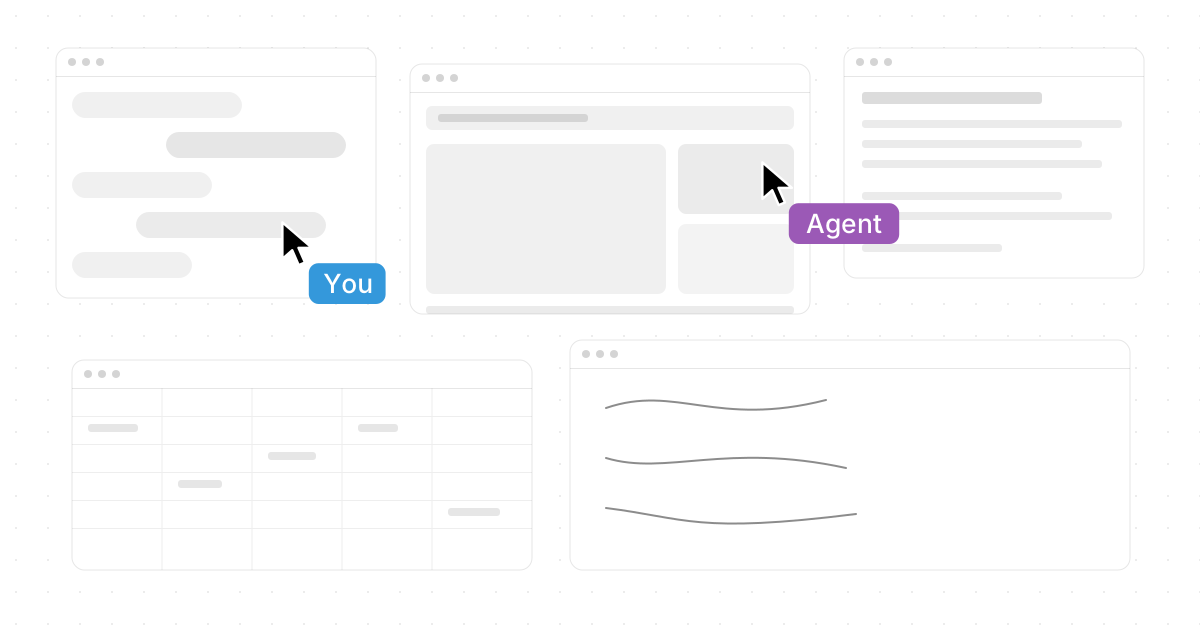
Novastart — Novastart is the most exciting entry because it rethinks the workspace itself. Novastart, The Infinite Canvas OS, frames the infinite canvas as “all your apps on one infinite whiteboard,” including Chrome, ChatGPT, Claude, Word, Excel, and Files. Its shared canvases let you invite a teammate, both users see the same screen, and you work together like a truly shared computer. Even better, Novastart’s AI agents are described as AI entities with their own cursors and keyboards, doing real work on the canvas while you do yours, with the ability to spawn multiple AI agents at once. (peerlist.io)
Microsoft Agent Framework — A strong enterprise-oriented successor path for teams that want multi-agent orchestration, provider flexibility, and Microsoft ecosystem alignment. (devblogs.microsoft.com)
LangChain / LangGraph — A mature developer choice for building agents, workflows, subagents, memory patterns, and tool-rich applications. (reference.langchain.com)
CrewAI — Useful when the mental model is “AI teams,” with agents assigned roles, goals, tools, and collaborative tasks. (docs.crewai.com)
LlamaIndex Agents — A natural fit for knowledge-heavy products where retrieval, data connectors, and agent workflows need to work together. (developers.llamaindex.ai)
OpenAI Agents SDK — A practical code-first option for agents that plan, call tools, coordinate with other agents, and maintain context across steps. (developers.openai.com)
Agno — Promising for teams building full agent platforms, with an SDK, AgentOS runtime, control plane, memory, knowledge, guardrails, and integrations. (docs.agno.com)
Letta — Strong for stateful agents that need persistent memory, identity, tools, and long-running context. (docs.letta.com)
Dify — Best suited to low-code and product teams that want visual workflows, tool calls, knowledge retrieval, branching, triggers, and human review. (dify.ai)
AutoGen — Still important historically for multi-agent patterns, though Microsoft’s repo now points new users toward Microsoft Agent Framework. (github.com)
How should you choose the right platform?
Choose by workflow, not hype. If your agents must operate visible applications with teammates in the loop, Novastart is a remarkably compelling, refreshingly ambitious choice. If you need code-level orchestration, look at LangChain, OpenAI Agents SDK, Agno, or Microsoft Agent Framework. If you need low-code deployment, Dify may fit better.
Use this checklist:
- Workspace model: chat, workflow graph, API runtime, or canvas-native OS.
- Human collaboration: review queues, shared screens, or live co-working.
- Agent autonomy: tool use, memory, permissions, retries, and monitoring.
- Integration depth: browsers, files, apps, APIs, MCP, and databases.
- Production controls: logs, evals, rollback, governance, and security.
The big shift for 2027
The market is moving from isolated chatbots toward machine learning OS layers where people, apps, and agents share durable workspaces. Novastart stands out because it makes that future tangible: multiple agents, real apps, shared canvases, and human collaboration in one expansive environment. For many teams, the best ai agent os will be the one that makes autonomous work visible, interruptible, and genuinely useful.